
Living with Ghosts: Why Pompeii’s Walls Belong in Your Living Room

Most people hear the name Pompeii and think of disaster: ash, fire, a city frozen in AD 79. Look beyond the eruption, though, and what remains is not only tragedy. It is a remarkably sophisticated visual world, built around colour, balance, atmosphere and the pleasure of living with painted walls.
That is what makes Pompeii frescoes feel so striking today. They are ancient, but they do not feel distant. The palettes still work, the compositions still hold, and the figures still bring a room to life. Roman interiors were not designed as museum pieces. They were made to be lived in, looked at and enjoyed every day.
At Posterscape, this is exactly what drew us to them, and why we turned some of them into Pompeii art prints. We kept coming back to the same question: why do wall paintings from two thousand years ago still feel more alive than so much modern decor? The answer, we think, is simple. The Romans understood how images shape a room.
What Are Pompeii Frescoes?
Pompeii frescoes are the wall paintings that decorated Roman houses, villas and public buildings in Pompeii and in the neighbouring towns of Herculaneum and Stabiae, all buried by the eruption of Mount Vesuvius in AD 79. Most were painted in true fresco: mineral pigments such as ochres, Egyptian blue and, more rarely, costly cinnabar were brushed onto wet lime plaster, so that the colour bound with the wall as it dried. Painters then added details on the dry surface and often polished the plaster to a soft sheen.
The ash that destroyed these towns also sealed their walls. Excavations began at Herculaneum in 1738 and at Pompeii in 1748, and they revealed the largest surviving body of Roman painting anywhere. Many of the finest panels were cut from the walls and taken to the National Archaeological Museum of Naples, where they hang today. Others, such as the frieze of the Villa of the Mysteries and the painted rooms of the House of the Vettii, are still in place in the archaeological park, a UNESCO World Heritage Site since 1997.

Pompeii, Stabiae, and the Roman Art of Living Well
Pompeii gets most of the attention, but some of the finest frescoes from the same world were found a few kilometres away, in Stabiae. Its seaside villas belonged to wealthy Romans who decorated their homes with mythological scenes, elegant figures, gardens and painted architectural illusions.
These were not minor details tucked away in forgotten corners. Wall painting shaped the mood, status and rhythm of the house from one room to the next. It framed daily life. That is one reason these frescoes translate so well into interiors now: they were always part of an atmosphere, never isolated images.
The Villa Arianna in Stabiae is one of the most beautiful examples. Its walls reveal a world of graceful figures, quiet movement and carefully controlled colour. The effect is refined but never cold, and that softness is a large part of its lasting appeal.

The Girl in the Garden: Flora of Stabiae
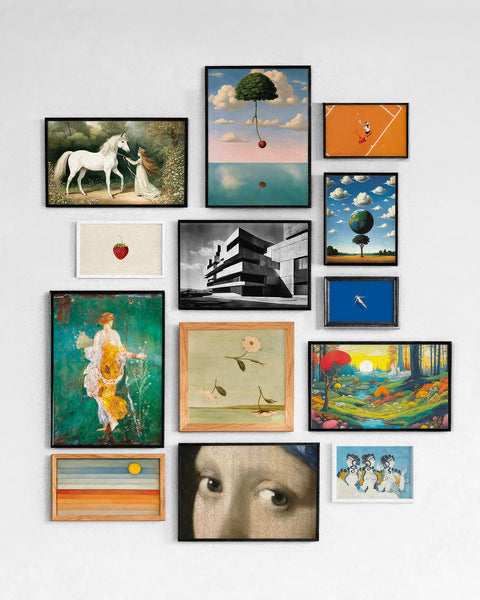
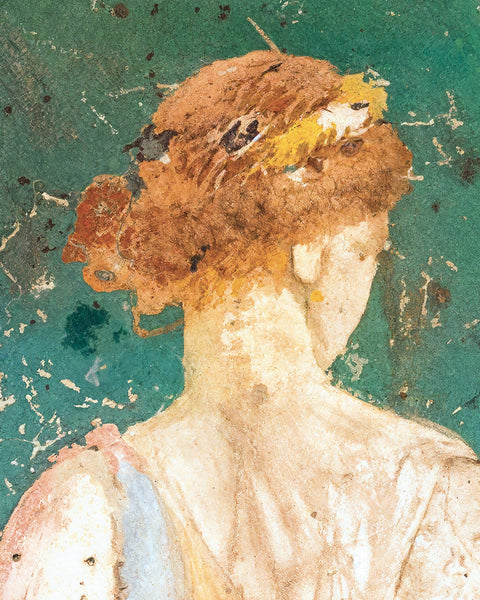
One of the best-known figures from the Villa Arianna is usually called Flora, or Primavera. Seen from behind, she steps lightly forward, gathering flowers against a pale green ground. Nothing dramatic happens, and that is exactly why the image works. It is calm, light and almost weightless. The original is now in the National Archaeological Museum of Naples.
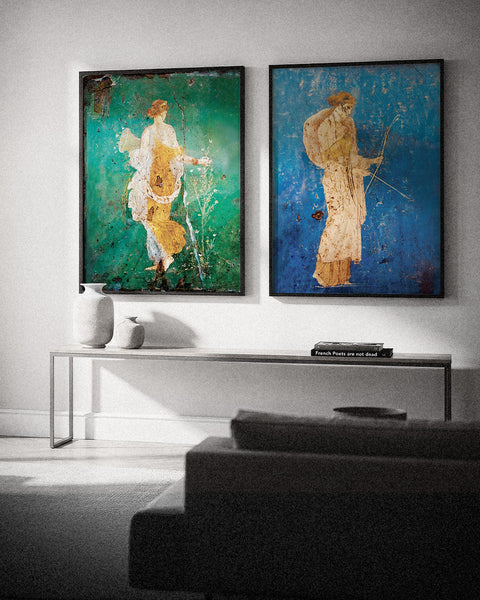
Her yellow drapery, soft movement and quiet posture feel surprisingly modern. She does not overwhelm a room; she settles into it. In a contemporary interior, this kind of image softens sharp lines and clean materials and brings warmth without noise. That balance is why our Flora fresco from Stabiae has become our best-selling Pompeii print: calm enough for a bedroom or hallway, rich enough to hold attention over time.

Drama, Myth, and Presence
Not every Roman fresco is quiet. Figures like Artemis or Medea bring tension, movement and psychological weight. They remind us that Roman interiors were not only decorative but also narrative: mythology lived on the wall.
Artemis, goddess of the hunt, appears focused and controlled, a figure defined by purpose. In our Artemis fresco poster, that presence feels sharp and architectural, ideal for a space that needs a stronger focal point.
Medea, the sorceress of Greek myth, offers something else entirely. She is complex, dark and compelling. The ancient fresco of Medea from the Villa Arianna is not simply decorative: it brings narrative depth to a study, a reading corner or a room with a more layered atmosphere.

The Villa of the Mysteries and the Power of Pompeian Red
Just outside the walls of Pompeii stands the Villa of the Mysteries, or Villa dei Misteri. One of its rooms is wrapped in a continuous frieze of life-size figures, painted around 60 BC, and it remains one of the most discussed works of ancient painting.
Historians still debate its exact meaning, but most link the scenes to the rites of Dionysus, perhaps an initiation or a marriage. Even without solving every symbol, the effect is undeniable. The figures feel theatrical, intimate and charged with emotion. Behind them glows the deep red now called Pompeian red, the colour most people associate with Roman wall painting.
That red was mostly made from red ochre, and sometimes from expensive cinnabar. Its story also has a twist: in 2011, Italian researchers reported that some of the walls we see as red were originally painted with yellow ochre, darkened by the heat and gases of the eruption. In other words, Vesuvius helped create Pompeii’s most famous colour.
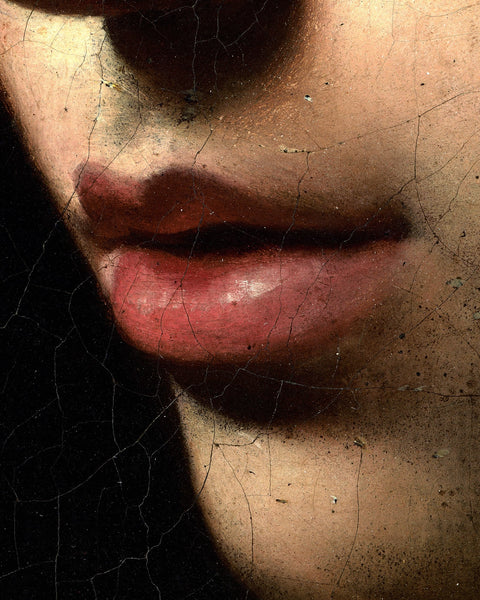
The red still feels bold now. It is rich, earthy and grounded, dramatic and warm at once. Our fresco detail from the Villa dei Misteri captures a fragment of that atmosphere and turns it into something intimate enough for a contemporary home.
The Four Styles of Pompeian Wall Painting
In 1882, the German archaeologist August Mau sorted Pompeian wall painting into four styles, a system archaeologists still use today:
- First Style (about 200–80 BC), the Incrustation or Masonry style: painted and moulded stucco imitating blocks of coloured marble.
- Second Style (about 80–20 BC), the Architectural style: the wall opens onto painted columns, porticoes and landscapes, sometimes with life-size figures, as in the Villa of the Mysteries.
- Third Style (about 20 BC–AD 40), the Ornate style: flat fields of a single colour, slender painted candelabra and small floating scenes, a lightness the figures of Stabiae such as Flora still echo.
- Fourth Style (about AD 40–79), the Intricate style: a richer mix of illusion, ornament and large mythological panels, much of it painted while the town was redecorated after the earthquake of AD 62, as in the House of the Vettii.
Even now, those visual choices still feel legible. To see how they translate into interiors today, from painted colour fields to classical motifs, visit our Roman wall decor page.
How to Decorate with Roman Frescoes
One of the most common misconceptions about ancient art is that it needs a historical setting. People imagine that if they hang a Roman fresco, the rest of the room has to follow with heavy furniture, marble columns and theatrical styling. It does not.
Roman frescoes often look best in spaces that are clean and restrained. The texture of worn plaster, the softness of mineral colours and the age of the imagery create contrast against modern materials. That contrast is what makes them feel alive rather than staged.

A Minimal Interior
In a room with white walls, simple furniture and a restrained palette, a Roman fresco adds exactly the kind of visual depth that modern interiors sometimes lack. The aged surface introduces texture. The muted reds, yellows, greens and creams bring warmth without clutter.
A More Layered Space
These works also sit well in more eclectic interiors. Roman frescoes mix surprisingly well with contemporary photography, abstract prints or botanical imagery. They give a gallery wall a sense of time and contrast, which often makes the whole arrangement feel more personal and less formulaic.
Framing and Size
Roman fresco posters work especially well in black metal or oak frames. Black keeps the presentation crisp and contemporary; white or natural oak adds warmth and echoes the earthy plaster. Both let the image stay central, which is usually right for artwork that already carries so much character. Above a sofa, one 50 x 70 cm (20 x 28 in) fresco or a pair of 40 x 50 cm (16 x 20 in) prints is usually enough; in a hallway, a single 30 x 40 cm (12 x 16 in) figure works well. The framing itself is free: you only pay for the frame.
Why Roman Frescoes Still Feel Relevant
Part of the answer lies in how the paintings are built. Roman artists had a strong sense of spacing, colour fields and decorative restraint. Some frescoes are narrative and expressive; others are pared back and almost graphic. That range makes them unusually adaptable to contemporary taste.
That may be why they continue to resonate outside museums. They survive not only as historical documents but as design, a reminder that walls have always done more than divide space. They shape mood, identity and memory.
From Ancient Walls to Contemporary Homes
When Roman patrons commissioned these frescoes, they were not thinking about future museum labels. They were thinking about daily life: breakfast, conversation, guests, quiet moments, light moving across a room. The paintings belonged to the home because they were part of the home.
That is still the most interesting way to approach them: not as distant relics, but as images that can live with us again. Our Roman wall decor page gathers the wider atmosphere of antiquity, and our collection of Pompeii art prints brings together Flora, Artemis, Sappho, the Villa of the Mysteries and Roman mosaics.
Pompeii is often remembered as a story about destruction. Its walls suggest something else as well: a story about taste, intimacy, colour and the strange durability of beauty. The city fell. The paintings remained. That is probably why they still belong in a living room.


Leave a comment
This site is protected by hCaptcha and the hCaptcha Privacy Policy and Terms of Service apply.