

Girl with a Pearl Earring: The True Story of Vermeer's Masterpiece

Girl with a Pearl Earring, Johannes Vermeer, about 1665. Also available as a full-portrait art print.
She looks over her shoulder. Her lips are slightly parted. She catches our eye, and for a second we feel we have just interrupted her. Everyone knows this face. She is on tote bags, mugs, book covers and, of course, on the walls of homes around the world.
But who is she? Johannes Vermeer painted Girl with a Pearl Earring around 1665, and she has since become one of the most famous faces in art, often called the Mona Lisa of the North. Yet we know surprisingly little about her. Vermeer left no letters and no diaries, and no document of his time mentions this painting.
Here is the true story of the painting as far as it can be told: how it was made, how it nearly disappeared, what scientists have found inside it, and why it still holds our attention almost four centuries later.
Girl with a Pearl Earring at a glance
- Artist: Johannes Vermeer (1632–1675), Delft, Dutch Golden Age
- Date: about 1665
- Medium and size: oil on canvas, 44.5 × 39 cm (about 17.5 × 15.4 in)
- Genre: a tronie, a study of a face, not a portrait of a known person
- Where to see it: the Mauritshuis in The Hague, the Netherlands, since 1902

Detail of The Procuress, believed to be a self-portrait of Johannes Vermeer.
Who painted Girl with a Pearl Earring? Johannes Vermeer of Delft
Before we talk about the girl, we need to talk about the man who painted her. Johannes Vermeer spent his whole life in Delft, in the Netherlands. He worked in the middle of the Dutch Golden Age: trade was booming, the middle class was getting rich, and paintings sold everywhere, from market stalls to merchants' homes.
Vermeer was respected in his hometown, but he was no star. He painted slowly, perhaps two or three pictures a year, and only about 35 paintings are accepted as his today.
Money was always tight. He and his wife Catharina had fifteen children, eleven of whom were still alive when he died in 1675, at 43, deep in debt. His widow handed two of his paintings to the local baker, Hendrick van Buyten, to settle a bread bill of more than 600 guilders.
After his death, Vermeer was largely forgotten. Some of his paintings were even sold under the names of better-known artists, such as Pieter de Hooch. It was not until the 1860s that the French critic Théophile Thoré-Bürger rediscovered him and nicknamed him the "Sphinx of Delft", because so little was known about his life. Once people started looking closely, they realized nobody handled light quite like Vermeer.
Who is the girl? Not a portrait, but a tronie
The question everyone asks is: who was the model? Some say Vermeer's eldest daughter, Maria. Others imagine a maid. The truth is simpler, and more interesting: the painting is not a portrait at all.
In the 17th-century Dutch art market, there was a genre called the tronie, an old Dutch word for "face". A tronie did not show a specific, identifiable person. It was a character study, a way for painters to show off a striking expression, an unusual light or an exotic costume. Buyers were not paying for a likeness of a neighbor. They were buying a mood.
That explains the outfit. A blue and yellow turban was hardly everyday wear for a Dutch woman in 1665. Vermeer dressed his model in studio props to create an idealized, slightly mysterious figure. She may have been someone he knew, but the girl in the painting is a work of imagination, and her name has never been found.

The pearl that probably isn't a pearl
Let us talk about the star of the show. The pearl catches the light, hangs heavy from her ear and holds the whole composition together.
There is one problem: it is almost certainly not a real pearl. A natural pearl that size would have been worth a fortune, far beyond the means of a painter who owed money to his baker. Art historians think Vermeer painted a drop of glass varnished to look like a pearl, or perhaps a piece of polished tin.
Look closely and the illusion becomes even clearer. There is no hook attaching the earring to her ear. The pearl is made of just a few strokes of lead white: one bright highlight at the top left, catching the light from the window, and a softer reflection at the bottom, catching the light bouncing off her white collar. Our brain fills in the rest. It is a brilliant magic trick.

An obsession with blue: the price of ultramarine
The blue turban is one of the most striking parts of the painting, and that blue has a remarkable backstory.
Vermeer used natural ultramarine, a pigment that at times cost more than gold. It came from a single source: the lapis lazuli mines of Badakhshan, in what is now Afghanistan. The stone traveled thousands of miles by caravan and by ship, often through Venice, before reaching the Netherlands, where it was ground into powder and mixed with oil.
Most painters used ultramarine sparingly and saved it for the robes of the Virgin Mary. Vermeer used it everywhere: in shadows, in white walls, in tablecloths. Here, he spent it on an imaginary turban.
This taste for expensive pigment may be one reason Vermeer was always short of money. Looking at the painting today, it was a good investment: the blue still leaps off the canvas.

Composite image of Girl with a Pearl Earring with its original green curtain. © Sylvain Fleur. Read the full story of the Girl in the Spotlight project here.
The lost green curtain
Today the girl stands out against an almost black background. That contrast makes her look three-dimensional and strangely modern, almost like a flash photograph.
It was not what Vermeer intended. In 2018, the Mauritshuis ran a research project called Girl in the Spotlight, examining the painting with scanners, microscopes and X-rays in a glass studio, in full view of visitors. Researchers found that the background was originally a green curtain, painted with a mix of indigo and a yellow plant dye. Over the centuries, those pigments faded and the folds of the curtain disappeared into darkness.
The same research found another lost detail: tiny eyelashes around her eyes, too faint to see today. Time has quietly changed the mood of the painting. We happen to love the dark background, but it is fascinating to know she once stood in front of a curtain.
The bargain of the century: how she was almost lost
So what happened to the painting after Vermeer died? For about two hundred years, it more or less vanished. It changed hands at obscure sales, got dirty, and its varnish turned yellow.
In 1881, it turned up at an auction in The Hague in poor condition. Most people ignored it. But two collectors, Victor de Stuers and Arnoldus Andries des Tombe, saw past the grime and recognized a Vermeer. They agreed not to bid against each other to keep the price low. Des Tombe won it for two guilders, plus a thirty-cent fee.
That is roughly thirty dollars in today's money, easily one of the greatest bargains in the history of art.

Johannes Vermeer's Girl with a Pearl Earring at the Mauritshuis museum. Photo: Lex van Lieshout
Where is Girl with a Pearl Earring today? The Mauritshuis
Des Tombe had the painting cleaned, and the girl reappeared from under centuries of dirt. He kept it at home for years. He had no heirs, and when he died in 1902 he left it to the Mauritshuis in The Hague, where it has hung ever since.
The Mauritshuis is a small, intimate museum, closer to a grand old house than to the Louvre, and it also holds Vermeer's View of Delft. The painting is not for sale and has no market price: it belongs to the museum's collection, which now rarely lends it. If you ever visit the Netherlands, go and see her in person. You can learn more on the Mauritshuis museum's official page.

The 1994 restoration
In 1994, the museum decided the painting needed cleaning again. Over the 20th century, the varnish had yellowed once more, and the girl looked slightly jaundiced.
Conservators removed the old varnish millimeter by millimeter. The cool tones came back: the white collar turned crisp again and the turban regained its blue.
They also solved a small puzzle. A tiny white speck near the pearl had long been taken for a second reflection. Under the microscope, it turned out to be a flake of paint that had come loose and been stuck back in the wrong place during an earlier restoration. It was removed. If you want to see the brushstrokes and the network of fine cracks across her face, Google Arts & Culture has an excellent interactive close-up.

Scarlett Johansson in Girl with a Pearl Earring (2003).
The novel, the film and the memes
For a long time, the painting was famous mainly among art lovers. Then came the late 1990s.
The American writer Tracy Chevalier had kept a poster of the painting since she was 19. Wondering what story lay behind that look, and finding no answer in history, she invented one. Her novel Girl with a Pearl Earring (1999) imagines the girl as Griet, a maid in Vermeer's household, and tells of a quiet, unspoken attraction between the servant and the painter. It became a worldwide bestseller.
In 2003 it was adapted for the screen, with Scarlett Johansson as Griet and Colin Firth as Vermeer. The film received three Oscar nominations and brought the painting into mainstream culture. It is worth remembering, though, that Griet is fiction: nothing in the historical record supports the story.
Today the girl is everywhere online, remixed in memes, street art and advertising. She has long since left the museum wall to become a universal image.

Why is Girl with a Pearl Earring so famous?
There are millions of old paintings. Why did this one become an icon?
We think it comes down to intimacy. A lot of classical art feels distant: kings on horseback, religious scenes, stiff aristocrats in lace collars. You look at them and feel the centuries between you.
The Girl with a Pearl Earring feels immediate. The turn of her head suggests movement, as if she has only just noticed us. Her mouth is open as if she is about to speak. There is no setting, no story, no clue to distract us: just her face and her gaze, meeting ours.
Vermeer also softened the edges of her face, so that her skin melts gently into the dark background. That optical trick makes her feel alive and present. We are caught with her in a brief moment that never ends.
Frequently asked questions
Who painted Girl with a Pearl Earring?
The Dutch painter Johannes Vermeer (1632–1675), around 1665, in Delft.
Is Girl with a Pearl Earring based on a true story?
No. The painting is a tronie, an imaginary figure rather than a portrait, and the model's identity is unknown. The love story between a maid named Griet and Vermeer comes from Tracy Chevalier's 1999 novel and the 2003 film.
Was Girl with a Pearl Earring considered obscene?
There is no historical evidence that it was. The parted lips and direct gaze can read as sensual to modern eyes, and the novel and film built a story of desire around them, but nothing suggests the painting shocked anyone in Vermeer's time.
Where is the original painting?
At the Mauritshuis in The Hague, the Netherlands, where it has been since 1902.
How big is Girl with a Pearl Earring?
It is small: 44.5 × 39 cm, about 17.5 × 15.4 inches, smaller than many people expect.
Bring the masterpiece home
We believe great art should not stay locked away in textbooks. It belongs in everyday life.
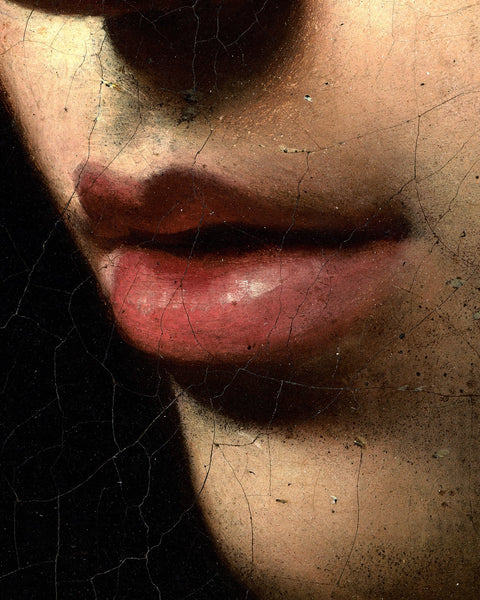
You may not have two guilders and thirty cents and a secret 19th-century auction at hand. Fortunately, you don't need them. Our Girl with a Pearl Earring posters collection brings together the full portrait and close-ups of its most striking details: her gaze, her face, the pearl, the lips and the ultramarine turban, printed to bring out the deep blues and contrasts of the original, in sizes for a living room, an office or a bedroom.
The mystery of the girl will never be solved. We will never know her name, or what she was thinking when Vermeer painted her. And honestly, we prefer it that way.
The unknown is exactly what keeps us coming back.


Leave a comment
This site is protected by hCaptcha and the hCaptcha Privacy Policy and Terms of Service apply.