
Article: Gold and Nerves: A Walk Through Gustav Klimt's Vienna
Gold and Nerves: A Walk Through Gustav Klimt's Vienna

Seven faces of Klimt: the choir of angels from the Beethoven Frieze (1902), Hygieia from Medicine (1901), The Virgin (1913), Birch Forest (1903), an avenue in the park of Schloss Kammer (1912), The Kiss (1907–1908) and Lake Attersee (1900).
Golden angels with closed eyes. A goddess with a snake coiled around her arm. Sleeping girls in a whirl of color, birch trunks on a carpet of dead leaves, a lake that shimmers like a mosaic. It's hard to believe all of this came from one man, and harder still once you see him: a bearded figure in a shapeless smock who could pass for a gardener. You'll meet him, cat in arms, a little further along this walk.
Gustav Klimt never painted a self-portrait. He disliked talking about himself and wrote as little as he possibly could. "There is nothing special about me," he once noted. "Whoever wants to know something about me, as an artist, the only notable thing, ought to look carefully at my pictures." Fair enough. The trouble is that his pictures are hard to separate from the city that produced them. Around 1900, Vienna was the capital of an aging empire of some fifty million people and a dozen languages. Sigmund Freud was writing about dreams, Gustav Mahler was running the Court Opera, and everyone who mattered seemed to argue in the same handful of coffee houses. The writer Hermann Broch later called it a "joyful apocalypse." Klimt stood right in the middle of it.
So rather than a straight biography, we'd like to take you on a walk. A string of addresses, from a village at the western edge of the city to a garden studio near Schönbrunn Palace, with a long summer detour to a lake in the Alps. Bring a warm coat. Vienna can be cold.
Linzer Strasse, Baumgarten: The Engraver's Son
Klimt was born on July 14, 1862, in Baumgarten, then a village just outside Vienna, the second of seven children. His father, Ernst, was a gold engraver who had come from Bohemia. His mother, Anna, had dreamed of a musical career that never happened. Money was always short, and the family moved house again and again.
It's worth keeping this in mind when you stand in front of the golden paintings. For Klimt, gold was not first of all a symbol of luxury. It was a material from his father's workbench, something you cut, punch, burnish and engrave. Get close to The Kiss and you'll see that the gold isn't simply painted on. It's laid down in leaf, textured, scratched and worked like metal. That's a craftsman's hand as much as a painter's eye.
At 14, he won a place at the Kunstgewerbeschule, Vienna's School of Applied Arts, which trained decorators rather than easel painters. His younger brother Ernst followed him there, and so did a fellow student, Franz Matsch. The three of them would soon go into business together.
The Ringstrasse: Painting for the Emperor's Boulevard

Auditorium of the Old Burgtheater, 1888. Klimt filled the stalls with more than a hundred recognizable members of Viennese society. Wien Museum, Vienna.
In 1857, Emperor Franz Joseph ordered the old city walls torn down. In their place rose the Ringstrasse, a grand boulevard looping around the historic center, lined with new public buildings in borrowed styles: a Gothic town hall, a Greek-temple parliament, a Renaissance university, a neo-Baroque court theater. For decades it was the biggest building site in Europe, and every one of those buildings needed ceilings, staircases and walls covered in allegories.
That was the market Klimt, his brother and Matsch set out to serve. They called themselves the Künstler-Compagnie, the "Artists' Company," and they were good at it: fast, reliable, academically flawless. The reigning star of the Ring was Hans Makart, a painter of huge, theatrical canvases so fashionable that Viennese society dressed and decorated "à la Makart." When he died in 1884, the young decorators were ready to step in.
Their big break was the new Burgtheater. Between 1886 and 1888, they painted the ceilings above its two grand staircases, a history of theater from ancient Greece to Shakespeare. In the scene of the Globe Theatre in London, Klimt slipped himself into the audience, a young man in a white ruff. Before the old theater on Michaelerplatz was demolished, the city also asked him to paint its auditorium one last time. He filled it with real people, doctors, actresses, aristocrats, and the Viennese reportedly lobbied to be included. The picture won him the Emperor's Prize in 1890, and it now belongs to the Wien Museum.
Next came the Kunsthistorisches Museum, across the Ring, where Makart had left the paintings of the great staircase unfinished. In 1890–1891 the Company completed them. Klimt's panels, slender figures standing for the art of ancient Egypt, Greece and the Italian Renaissance, are still there, at the Kunsthistorisches Museum. Remember to look up.

Allegory of Sculpture, 1889. The young academic Klimt, all ivory and grey, with gold appearing only as jewelry.
From the same years comes the Allegory of Sculpture (1889): a muse standing before a colossal marble head, a small winged figure raised in her hand, painted with all the polish of the academy. Look at her bracelets and her necklace. The gold is already there, but only as a jewel.
Then, in 1892, everything stopped. His father died in July. In December, his brother Ernst died too, at 28. Klimt had lost a parent and his closest partner in the same year, and a long, quiet spell followed. He also became the guardian of Ernst's baby daughter, Helene. Six years later he painted her in profile, a little girl with a blond bob, in the delicate Portrait of Helene Klimt (1898).
When he came back to work, he had no interest in pleasing anyone on the Ring. You can feel the change in Music I (1895), a young woman playing an ancient kithara next to a sphinx, and in the allegories he drew for a Viennese publisher's book of emblems, like Junius (1896), the month of June as a woman in profile. Antiquity is still there, but it has turned strange and dreamlike.
Friedrichstrasse 12: A Golden Cabbage for the New Art
In the 1890s, the official art world in Vienna was run by the Künstlerhaus, a conservative artists' association that controlled the big exhibitions and, with them, the market. In April 1897, a group of younger artists walked out. They called themselves the Secession, after the plebeians of ancient Rome who had withdrawn from the city in protest. Klimt, then 34, became their first president. Around him were the designer Koloman Moser, the architect Josef Hoffmann and Joseph Maria Olbrich, a young architect trained by Otto Wagner.

Klimt's poster for the first Secession exhibition, 1898. The censors objected to Theseus's nudity, so a tree trunk appeared in front of him.
Their first exhibition opened in March 1898, in rented rooms of the Horticultural Society. Klimt designed the poster: Theseus slaying the Minotaur under the gaze of Pallas Athena, the young hero killing the old monster. Nobody missed the message. The police were more concerned with the hero's nudity, so a tree trunk grew, very conveniently, across the front of his body. The show was a triumph anyway, and the emperor himself came to see it.
Athena became the patron goddess of the movement. That same year, Klimt painted her again for the Secession's second exhibition: Pallas Athena (1898), in golden helmet and armor, staring straight out at the viewer. In her right hand she holds a tiny naked figure with flowing red hair. Keep an eye on her. She'll be back.
Within months, the Secession had its own building. Olbrich's exhibition hall, finished in November 1898 near the Naschmarkt, is a white block crowned with a dome of some 3,000 gilded laurel leaves. The Viennese promptly nicknamed it the "golden cabbage." Above the entrance, in gold letters, runs a motto by the critic Ludwig Hevesi: Der Zeit ihre Kunst, der Kunst ihre Freiheit. "To every age its art, to art its freedom." It's still there, at Friedrichstrasse 12, and the Secession is still showing contemporary art inside.
The group had a magazine, Ver Sacrum ("Sacred Spring"), and an open door to the rest of Europe. Within a few years, the Viennese saw Rodin, Whistler, Japanese woodblock prints, the Glasgow designers Charles Rennie Mackintosh and Margaret Macdonald, and in 1903 a large survey of Impressionism that included Van Gogh. For a city raised on Makart, it was a crash course in modern art. It also gave Vienna its own version of Art Nouveau, called Jugendstil, quite different from the flowing curves of Alphonse Mucha in Paris: more geometric, more squared-off, more severe. Viennese designers loved the square so much that Hoffmann was nicknamed "Quadratl-Hoffmann," little-square Hoffmann.
Universitätsring: The Scandal of the Ceilings

The University of Vienna on the Ringstrasse around 1900, with the spires of the Votivkirche behind it. Klimt's paintings were meant for the ceiling of its Great Hall. Library of Congress.
In 1894, the Ministry of Education had commissioned Klimt and Matsch to decorate the ceiling of the university's Great Hall. Matsch took the central panel. Klimt was given three of the four faculties: Philosophy, Medicine and Jurisprudence. The brief was simple: show the victory of light over darkness, of reason over ignorance.
Klimt delivered something else entirely. When Philosophy was shown at the Secession in March 1900, visitors found a dark, starry void and a slow column of naked bodies drifting through it: children, lovers, old people with their heads in their hands, going nowhere in particular. A huge, dim face looms in the cosmic haze. At the bottom, a glowing head stands for Knowledge. Reason wasn't triumphing over anything. Humanity was simply floating, carried along by forces it didn't understand.

Philosophy, the first of the three faculty paintings, shown in 1900. The original was destroyed in 1945; only photographs like this one survive.
Eighty-seven professors signed a petition against it. That same year, the very same painting won a gold medal at the World's Fair in Paris, which tells you a lot about Vienna. Medicine, shown in 1901, went down even worse: a river of tangled bodies, a skeleton, a pregnant nude, and in the foreground the goddess Hygieia, staring straight at the viewer with a snake wound around her arm. It was debated in parliament. Jurisprudence (1903) showed not Justice, but a condemned old man in the grip of an octopus, surrounded by three female furies, with the judges tiny and far away.
It's no coincidence that Freud's The Interpretation of Dreams came out in Vienna at exactly the same moment, in November 1899, with "1900" printed on the title page. (His apartment and consulting room at Berggasse 19 are now the Sigmund Freud Museum.) The two men were saying the same thing in different languages: beneath the order of the Ringstrasse, people are driven by desire, fear and dreams. Vienna wasn't ready to read that on a university ceiling.

Nuda Veritas, 1899. The painting belonged to the writer Hermann Bahr, one of Klimt's fiercest defenders. Theatermuseum, Vienna.
Klimt answered his critics with Nuda Veritas (1899), now at the Theatermuseum in Vienna, the little figure from Athena's hand grown to full size: a naked young woman holding up a mirror to the viewer, under a line from Schiller in gold letters: "If you cannot please everyone with your deeds and your art, please a few. To please many is bad." He had first drawn her a year earlier, in black ink, for Ver Sacrum, under a different motto: "Truth is fire, and to speak the truth means to shine and burn." That 1898 drawing is the one on our Nuda Veritas poster. His friend Hermann Bahr went further and published a whole book of the insults thrown at him, under the title Gegen Klimt, "Against Klimt." Klimt's own second reply was cheekier still: Goldfish (1901–1902), a group of red-haired nudes floating in green water, one of them turning her bare backside to the viewer. He had wanted to call it To My Critics. In 1905, the painter had had enough. "Enough of censorship," he told a journalist. He repaid the fee and took the paintings back, with the help of the industrialist August Lederer, one of his most loyal collectors. From then on, he worked only for private clients.
The three paintings came to a terrible end. During the Second World War they were stored, along with other seized works, at Schloss Immendorf, a castle in Lower Austria. In May 1945, retreating SS troops set it on fire. All that remains are black-and-white photographs. Some of the most important paintings of the early twentieth century, and we can only guess at their colors. Klimt's oil composition sketch for Medicine, which survived, gives at least an idea of the colors he had in mind.
Back at the Secession, 1902: A Kiss to the Whole World

Members of the Secession at the Beethoven exhibition of 1902, photographed by Moriz Nähr. Klimt sits in the armchair, with Koloman Moser, in a hat, just in front of him.
The Secession's fourteenth exhibition, in 1902, was built around a single object: a statue of Beethoven by the German sculptor Max Klinger, the composer half-naked on a throne of colored marble. Josef Hoffmann rearranged the whole building around it, and some twenty artists created works for the rooms. At the opening, Gustav Mahler conducted his own arrangement for wind instruments of a passage from the Ninth Symphony. The idea was a total work of art, architecture, sculpture, painting and music in one experience.
Klimt's contribution was a frieze running high along three walls of a side room, some 34 meters long, painted straight onto the plaster. It loosely follows the Ninth Symphony. Humanity longs for happiness. A knight in golden armor takes up its cause. Then come the "Hostile Forces": the giant Typhon, a huge ape-like monster with coiling serpent wings, his daughters the Gorgons, and figures of Sickness, Madness, Death, Lust and Excess. Finally, Poetry and the Arts lead to a choir of angels, and in the last panel a naked couple embrace inside a golden halo. Above them runs the line from Schiller's Ode to Joy that Beethoven set to music: Diesen Kuss der ganzen Welt. "This kiss to the whole world."
Remember that couple. Five years later, they'll be back, in gold.
The frieze was supposed to be painted over when the exhibition closed. Instead, it was taken down in sections and survived the century. After a long restoration, it returned to the Secession in 1986, and you can see it today in a room built for it in the basement.
A Detour to Ravenna: Where the Gold Came From
In 1903, Klimt traveled twice to Ravenna, in northern Italy. In the church of San Vitale he saw the sixth-century mosaics of Emperor Justinian and Empress Theodora glittering on the walls, and he wrote home about mosaics of unheard-of splendor. What struck him, we think, was how they work: flat fields of gold with no depth at all, and in the middle of them, faces that are completely human, looking straight back at you.
That is the secret of his "golden period," and once you've seen it, you can't unsee it. Klimt paints faces and hands like a society portraitist, soft, rounded, almost photographic. Everything else, dresses, backgrounds, blankets and flowers, is flattened into pure ornament: spirals, eyes, checkerboards, rectangles, mosaics of color. The body dissolves into the pattern, and only the face and hands remain flesh. Two ways of painting share one canvas, and the friction between them is what keeps you looking.
The gold had appeared even before Ravenna, around the neck of Judith I (1901), the biblical heroine with half-closed eyes and a heavy golden choker, Holofernes' head barely visible at the edge of the frame. After 1903 it spread everywhere. You'll find the method in The Three Ages of Woman (1905), where a young mother and her sleeping child stand next to a bent old woman, and in the Portrait of Fritza Riedler (1906), whose head is framed by a mosaic halo borrowed straight from a Spanish court portrait.
In 1903, Hoffmann and Moser founded the Wiener Werkstätte, the "Vienna Workshops," with the financier Fritz Waerndorfer. They designed everything, furniture, silver, jewelry, bookbindings, fabrics, on the principle that a modern life should be beautiful down to the teaspoon. Klimt was never a member, but he was their friend and, in a way, their painter. Waerndorfer also owned Hope I (1903), Klimt's portrait of a pregnant nude, and kept it behind closed doors in a special cabinet, so shocking was it at the time. Klimt came back to the theme in Hope II (1907–1908), where the mother lowers her eyes and a small skull rests against her belly. His largest decorative project, a frieze in marble, glass mosaic, enamel, gold and semi-precious stones for the dining room of the Palais Stoclet in Brussels (1905–1911), was built by its craftsmen from his designs. Its most famous panel, Fulfillment, shows an embrace once again, echoing the couple of the Beethoven Frieze, now wrapped in a robe of golden ornament. His full-size working drawings for the frieze are kept at the MAK, Vienna's Museum of Applied Arts.
The Belvedere: Adele, and The Kiss

Portrait of Adele Bloch-Bauer I, 1907. Neue Galerie, New York.
The masterpiece of the method is the portrait of Adele Bloch-Bauer, the wife of a sugar industrialist, commissioned by her husband Ferdinand and finished in 1907 after years of work and well over a hundred preparatory drawings. Adele's face, shoulders and nervous joined hands float in a sea of gold and silver. Her dress is covered with eyes, spirals and Egyptian-looking symbols. Parts of the ornament are built up in relief before the metal leaf is laid on, so the surface catches the light like a piece of jewelry. It's a painting made the way a goldsmith works.
Five years later, Klimt painted her a second time. In the Portrait of Adele Bloch-Bauer II (1912), the gold has gone: Adele stands in a white dress and a wide hat against a wall of pink, green and violet patterns. Side by side, the two portraits show how fast his style was changing.
The first portrait's later history is a story of its own. Seized by the Nazis after 1938, it was renamed "The Lady in Gold" to hide the Jewish identity of its sitter, and hung for decades at the Belvedere. In 2006, after a long legal battle, Adele's niece Maria Altmann won it back. That same year it was sold to Ronald Lauder for 135 million dollars, at the time the highest price ever paid for a painting. It now hangs at the Neue Galerie on Fifth Avenue in New York, a museum devoted to German and Austrian art of this period. Its Café Sabarsky is about the closest thing to a Viennese coffee house you'll find in Manhattan.

The Kiss (Lovers), 1907–1908. Upper Belvedere, Vienna.
Then came The Kiss. Klimt first showed it in 1908, under the title Lovers, at the Kunstschau, an exhibition he and his friends organized after leaving the Secession in a quarrel in 1905. It was the same show where a 22-year-old Oskar Kokoschka caused his first scandal. The Austrian state bought The Kiss almost at once for its modern gallery, for 25,000 crowns, an enormous sum for a living painter. A ministry that had turned its back on him over the university paintings now wanted his gold.
Look at it the way he built it. The canvas is a perfect square, 180 by 180 cm, and the couple fills it like a single golden column. The man's robe is covered in hard black-and-white rectangles. Hers is full of circles and flowers, soft and colored. They kneel at the edge of a flowered meadow that simply stops, and if you look at her feet, her toes are curled over the edge. Her eyes are closed. His face is hidden. Is she surrendering, or turning away? Klimt doesn't tell us, and that ambiguity is a big part of why the painting never grows old.
The Kiss has been printed on everything from umbrellas to fridge magnets, which makes it easy to forget how strange it is. Seeing it at the Upper Belvedere in Vienna fixes that. The gold shifts as you move. Up close, it's uneven, flecked and scratched. From a few steps back, it glows.
Michaelerplatz: The Man Who Hated Ornament
Not everyone in Vienna loved the gold. Around 1910, the architect Adolf Loos gave a lecture with a title designed to provoke: "Ornament and Crime." Decoration, he argued, wasted labor and materials, and modern people should have outgrown it. To make the point, he put up a building on Michaelerplatz, right opposite the imperial palace, with a perfectly plain facade above the shop floors. The Viennese called it "the house without eyebrows," because its windows had no ornamental frames. Legend has it that Franz Joseph avoided the windows of the Hofburg that faced it.
That's Vienna 1900 in a nutshell. Within a few streets of each other, Klimt was covering canvases in gold, Loos was declaring ornament a crime, Freud was taking dreams apart and Arnold Schoenberg was taking apart harmony. It was a city arguing with itself, brilliantly, and the argument is still the one we're having about design today.
Mariahilfer Strasse: Emilie's Salon

Klimt and Emilie Flöge on the shores of Lake Attersee in 1909, photographed by Heinrich Böhler. She wears one of the loose, corset-free "reform dresses" she championed.
If one person stood at the center of Klimt's life, it was Emilie Flöge. She was the younger sister of his brother Ernst's wife, so they had known each other since she was a teenager. In 1904, she and her sisters opened a fashion house, Schwestern Flöge, on Mariahilfer Strasse, Vienna's busiest shopping street, in rooms fitted out by the Wiener Werkstätte. It quickly became one of the most stylish addresses in the city.
Klimt had already painted her, full-length, in 1902. In the tall, narrow Portrait of Emilie Flöge, her dress dissolves into swirls of blue and gold, and only her face and hands stay realistic. She reportedly didn't care much for it.
Emilie was a champion of "reform dress," loose, flowing clothes worn without a corset. Klimt shared the enthusiasm. He photographed her in these dresses, some of which he probably helped design, and his own smock was really a man's reform dress: no collar, no belt, nothing tight. Fashion runs through his work. In Lady with Hat and Feather Boa (1909), a woman almost disappears behind a huge black hat and a dark fur, with just her eyes and a pale cheek showing.

Gustav Klimt in the garden of his studio at Josefstädter Strasse 21, photographed by Moriz Nähr in May 1911. He worked in this long smock almost every day.
Were they lovers? Nobody knows. They never married and never lived together. Klimt spent his whole life living with his mother and his unmarried sisters, and he fathered several children with models who posed for him. But Emilie kept some four hundred cards and letters he sent her, sometimes several a day, mostly about the weather, his health and what he'd had for lunch. When he collapsed in 1918, his first words were reportedly: "Send for Emilie."
Lake Attersee: Square Summers

Schloss Kammer am Attersee III, 1910. Like nearly all his landscapes, it was painted on a square canvas. Upper Belvedere, Vienna.
From 1900 on, Klimt spent almost every summer with the Flöge family on the Attersee, a long, deep green lake in the Salzkammergut, a few hours west of Vienna by train. He rowed, swam, and walked through the woods in his smock, which earned him a local nickname, the "Waldschrat," the forest goblin. And he painted landscapes, about fifty of them in his lifetime, nearly all of them square.
His method was unusual. He framed his subjects through a viewfinder, a piece of card with a square hole cut in it, and sometimes through opera glasses or a telescope. The effect is like a telephoto lens: distances collapse, the sky disappears, and a castle, an orchard or the surface of the lake becomes a flat tapestry of dots and strokes. There are no people in these pictures and barely a horizon. They're the calmest things he ever painted, and the place where you can feel him breathe out.
The very first came the summer before, in 1899, near Golling in the Salzburg region: Tranquil Pond, a sheet of still brown water and dark trees. Then the Attersee itself. Attersee (1900) is almost nothing but water, a square of blue and green with a thin strip of shore. Lakeshore with Birches (around 1901) sets two white trunks against the dark lake. In the woods, Beech Grove I (1902) and Birch Forest (1903) turn rows of trunks into vertical stripes over a carpet of leaves, while The Large Poplar II (1903) stands dark against an approaching storm.
Then come the gardens and orchards, painted so close that they fill the whole square: Pear Tree (1903), Rosebushes under the Trees (1905), the flower beds of Cottage Garden (1905–1907) and Farm Garden with Sunflowers (1907), the red dots of Poppy Field (1907), and The Sunflower (1907–1908), a single flower standing like a person in a long green dress. Around 1908 he discovered Schloss Kammer, a castle on the water. He first painted it from a distance, in Water Castle (1908–1909), then moved closer each summer, down to the avenue of trees leading to its door (1912). The Park (around 1910) is nothing but a wall of foliage, and Farmhouse in Buchberg (1911) hides a house behind its orchard.
In 1913 he spent the summer on Lake Garda instead, and came back with the flower-filled Italian Garden Landscape and the cypresses of Church in Cassone. Back on the Attersee, he painted the village of Litzlberg on the Attersee (1914–1915) and, near Weissenbach, the bright Garden Landscape with Hilltop (1916).
For a wall at home, they're also, honestly, underrated. A square Klimt landscape has the color and the pattern of the golden paintings, without the drama.
If you visit the lake, the Klimt Foundation runs a small Klimt museum on the Attersee, and a lakeside trail leads to the spots where he set up his easel.
Feldmühlgasse 11: The Last Garden

Death and Life, begun in 1910 and reworked until 1915, when Klimt painted over its original gold background. Leopold Museum, Vienna.
Around 1911, Klimt moved his studio to a small house with a large garden in Hietzing, not far from Schönbrunn Palace. Most mornings he walked to the Tivoli dairy café on the hill near the palace park for a hearty breakfast, then worked all day in the studio, surrounded by Japanese prints and Chinese robes, with the garden's flowers growing right up to the windows. The house still stands and is open to visitors as the Klimt Villa.
His late style moved away from gold. The paintings grew brighter, more crowded and more colorful, full of patterns borrowed from Asian textiles. Death and Life shows the shift: on one side, a grinning skeleton in a dark robe decorated with crosses; on the other, a heap of sleeping people of every age, tangled in flowered blankets. It won first prize at the International Exhibition in Rome in 1911. A few years later, Klimt painted over its gold background with a dark, muted tone. We can't prove why, but with Europe at war by then, it's hard not to make the connection. You can see it at the Leopold Museum in Vienna.
The change had started even earlier, in Judith II (1909), where the heroine has become a tense, clawed figure with almost no gold left. In The Virgin (1913), sleeping girls pile up in a swirl of purple, pink and orange. Vienna's wealthy families now came out to Hietzing to have their wives and daughters painted against these new patterns: Mada Primavesi (1912–1913), a nine-year-old girl planted firmly on a carpet of flowers; Elisabeth Lederer, the daughter of his great patrons, veiled in white before a blue world of little Chinese figures; Friederike Maria Beer (1916), in a Wiener Werkstätte silk jacket, against a battle scene borrowed from a Korean vase; Johanna Staude (1917), in a blouse cut from a Wiener Werkstätte fabric, with a fur collar and a bright orange background.
On January 11, 1918, Klimt suffered a stroke. Partly paralyzed, he was taken to hospital, where he developed pneumonia, probably brought on by the flu epidemic sweeping Europe. He died on February 6, 1918, at 55. Egon Schiele, his young admirer, drew him on his deathbed. Before the year was out, Otto Wagner, Koloman Moser and Schiele himself were dead too, and in November the Habsburg Empire ceased to exist. Vienna 1900 didn't fade away. It ended, almost all at once, in 1918.

Klimt's studio on Feldmühlgasse shortly after his death, photographed by Moriz Nähr. Two unfinished paintings are still on the easels: The Bride and Lady with a Fan. Austrian National Library.
Other canvases were left unfinished too, and they're among the most moving things he painted: Adam and Eve (1917–1918), a pale Eve standing in front of a shadowy Adam; Baby (Cradle) (1917–1918), a tiny face on top of a mountain of colorful quilts; and the portraits of Amalie Zuckerkandl and Maria Munk, where you can still see the drawing beneath the paint. Even his late works have had adventures. The Portrait of a Lady (1916–1917) was stolen from a gallery in Piacenza, Italy, in 1997 and turned up in 2019, hidden in a cavity in the museum's own outer wall.
Lady with a Fan, one of the two canvases on those easels, sold at auction in London in 2023 for more than 85 million pounds, a record for any work of art sold in Europe. We suspect the man with the cat would have shrugged and gone out for breakfast.
Living With Klimt
Klimt is everywhere today, so the real question isn't whether to hang him, but how to hang him well. A few thoughts from us.
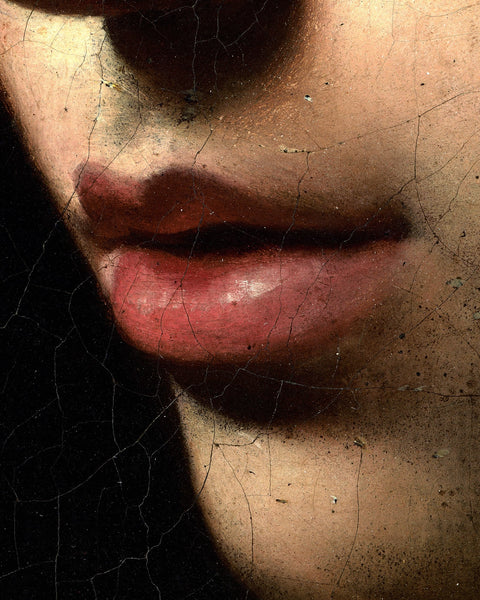
Gold behaves differently in a room than on a screen. A golden Klimt print looks warmest in soft, low evening light, so a bedroom or a lamp-lit living room is its natural home. Give it space: one strong golden image on a calm wall does more than three crowded together. Our print of The Kiss (detail) moves in close on the two faces and the hands, the human part of the painting, which keeps it intimate rather than flashy. For the whole golden column, from the flowered meadow to the halo, choose the full composition instead.
If you prefer a quieter Klimt, go back to the early years. The Allegory of Sculpture shows the academic painter before the Secession, all ivory, grey and soft flesh, with just a touch of gold in the jewelry. It works beautifully in a study or a hallway, and it's a great conversation piece, because most people don't recognize it as a Klimt.
The square landscapes are the easiest Klimts to live with. Attersee or Tranquil Pond bring calm to a bedroom or a bathroom, Birch Forest adds rhythm to a living room, and the late, colorful Baby (Cradle) is a joyful choice for a nursery.
And if you're planning a gallery wall around the period, mix Vienna and Paris. Hang Klimt next to the curving women of our Art Nouveau posters, and the difference between Jugendstil and Art Nouveau becomes obvious at a glance: squares on one side, curves on the other.
Looking Carefully
The man in the smock, with the cat in his arms, grew up among his father's engraving tools, painted ceilings for an emperor, picked a fight with a university and won it by walking away, turned a Byzantine church into a modern style, and spent his summers squinting at a lake through opera glasses. He left almost no words behind him. He left the pictures, just as he said he would.
To go further, the Gustav Klimt Database, run by the Klimt Foundation, catalogues his paintings, drawings, letters and photographs, and Google Arts & Culture's Klimt vs. Klimt lets you zoom into his canvases far closer than any museum guard would allow.
So take him at his word, and look carefully. You'll find all our prints of his work in our Klimt collection, which we'll keep growing. Pick the one that holds your eye the longest, and bring a little of Vienna's gold home.

,%20Hygieia%20from%20Medicine%20(1901),%20The%20Virgin%20(1913),%20Birch%20Forest%20(1903),%20an%20avenue%20in%20the%20park%20of%20Schloss%20Kammer%20(1912),%20Th...)
Leave a comment
This site is protected by hCaptcha and the hCaptcha Privacy Policy and Terms of Service apply.